Hoang Su Phi Rice Terraces: A Complete Guide for Trekkers
Walk inside the terrace country above the Chay river, understand its farming calendar and choose the route that fits your time, season and walking experience.
Hoang Su Phi rice terraces: on foot.
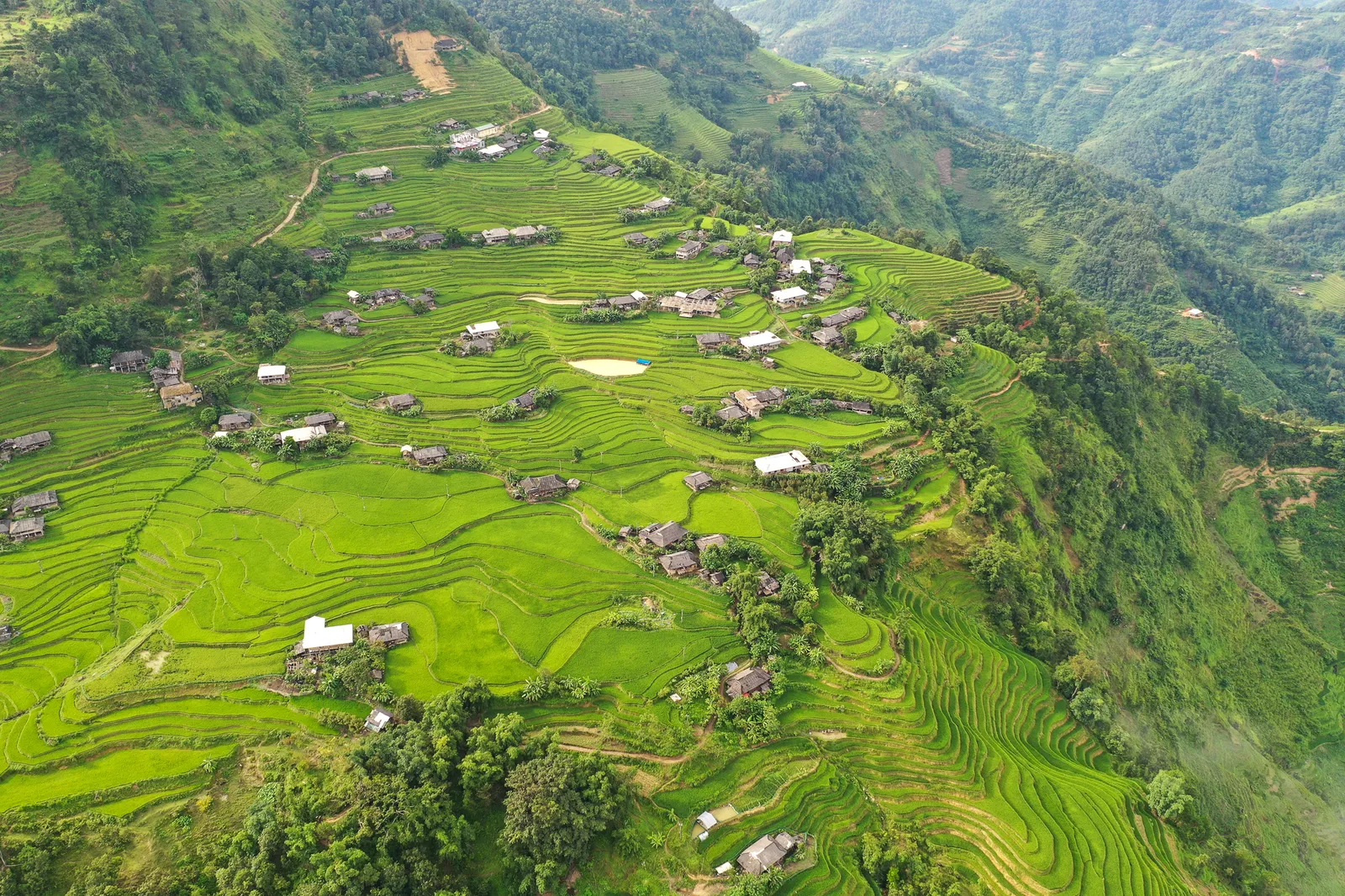
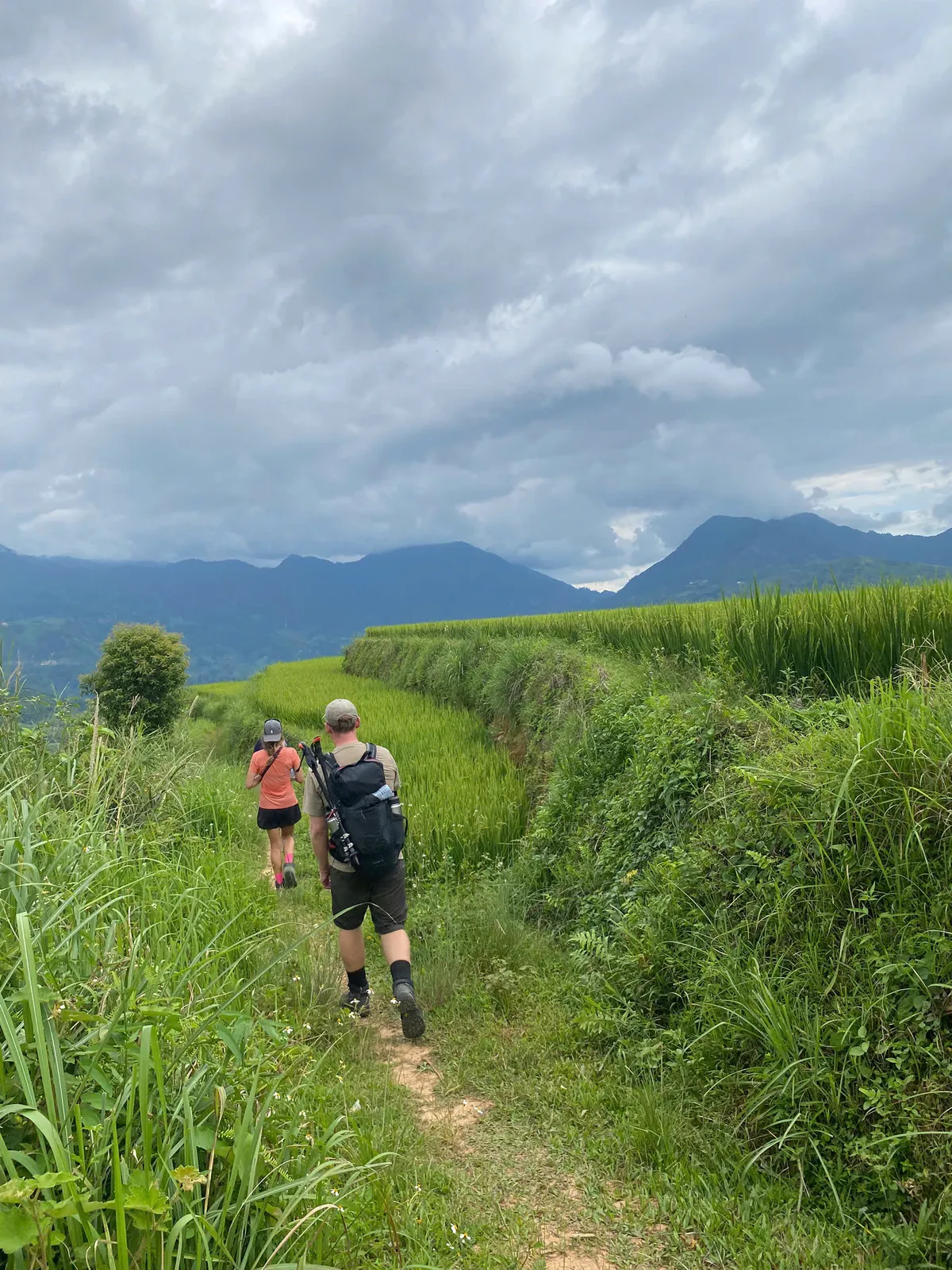
Hoang Su Phi’s rice terraces are a recognised cultural landscape shaped by generations of farming on steep western slopes. The best way to understand them is trekking or hiking on the paths between fields, hamlets and river valleys, not from a road pull-off.
The district sits where the Chay river cuts through La Chi terrace country and the land rises towards the Tay Con Linh massif. That geography creates a wide range of ground: warm river valleys, high planting slopes, forested ridges and cold upper mountain routes.
This guide follows the terrace calendar and the walking routes that cross it. Use the complete guide for the wider province and Plan Your Ha Giang Trek to compare the route difficulty before choosing a departure.
- The complete guide to trekking Ha Giang
Place Hoang Su Phi within the wider province.
- Plan Your Ha Giang Trek
Compare routes, season and difficulty.
- Best time to trek Ha Giang
Match the terrace calendar to your dates.
- Rice terrace trekking in Ha Giang
Terrace landscapes and published Hoang Su Phi programmes.
- Hoang Su Phi programmes
Compare routes, difficulty and seasons at this collection hub.
A working landscape, not a backdrop.
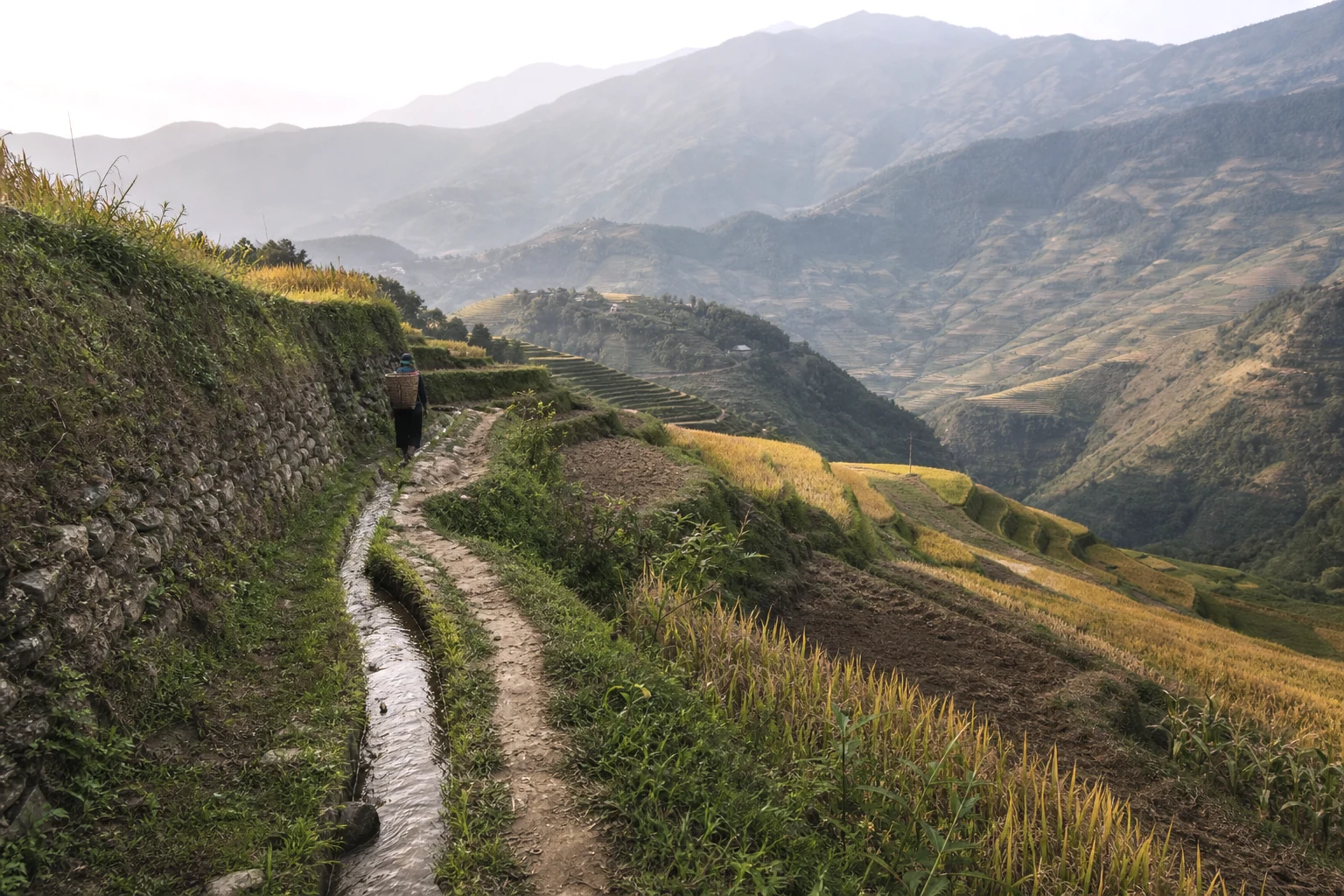
Terraces in Hoang Su Phi are working fields. Irrigation channels, narrow wall edges and paths between plots are part of the farming system, so the landscape changes with planting, rain and harvest rather than holding one fixed appearance for visitors.
Ban Phung above the Chay river is among the highest planting country in the district. Elsewhere, valleys and ridges link Red Dao, La Chi and Tay communities through fields, tea gardens and forest approaches.
Walking here means moving at the pace of the ground. A terrace day can include wet stone, short steep climbs and pauses for farmers carrying seedlings or harvest baskets; the route is more useful when it respects that daily rhythm.
- Ban Phung — highest terraces
A one-day Moderate terrace circuit.
- Nam Hong to Ho Thau
A two-day Moderate homestay and ridge programme.
- Ban Luoc long traverse
A three-day Demanding crossing through wider terrace country.
Planting water, green slopes and harvest gold.
May and June are planting season. Flooded paddies reflect the sky between terrace walls, seedlings appear in the fields and afternoons are warmer. Rain can slow the pace, but the water-filled landscape is distinct from both the green months and harvest.
June through August is the green season. Fields deepen in colour and paths can remain muddy after rain; terrace and village routes still walk with a slower, more weather-aware rhythm. Tay Con Linh programmes do not run from June through September.
Mid-September through October is the usual harvest window in most terrace villages. Higher plots can turn gold after lower paddies, so dates show a progression rather than one guaranteed day. The air is usually drier and the light longer, but harvest work still takes priority on the paths.
Planting and green season vs harvest season
| Planting and green (May – August) | Harvest (mid-September – October) | |
|---|---|---|
| Landscape | Flooded mirror terraces, seedlings and deepening green | Golden fields, cut straw and active harvest work |
| Footing | Softer ground and mud after rain; slower pace | Generally firmer paths, though stone can still be slick |
| Light | Mist, reflections and warmer afternoons | Longer dry-season light and clearer valley views |
| Walking approach | Build flexibility around rain and river conditions | Give way to farmers and allow time around harvest work |
Landscape
Planting and green (May – August)
Flooded mirror terraces, seedlings and deepening green
Harvest (mid-September – October)
Golden fields, cut straw and active harvest work
Footing
Planting and green (May – August)
Softer ground and mud after rain; slower pace
Harvest (mid-September – October)
Generally firmer paths, though stone can still be slick
Light
Planting and green (May – August)
Mist, reflections and warmer afternoons
Harvest (mid-September – October)
Longer dry-season light and clearer valley views
Walking approach
Planting and green (May – August)
Build flexibility around rain and river conditions
Harvest (mid-September – October)
Give way to farmers and allow time around harvest work
- Best time to trek Ha Giang
Month-by-month route conditions.
- Golden rice season in Hoang Su Phi
Harvest window deep-dive — footing, light and product fit.
- Green season trekking in Ha Giang
May – August planting water and monsoon pace.
- Packing for Ha Giang
Footwear and layers for changing terrace conditions.
Let the route set the picture.
Photography works best when it follows the walk. Planting season offers water and reflections in the morning; green season brings mist and saturated slopes; harvest rewards patient side-light across the Chay valley rather than a rushed search for a single viewpoint.
The paths are not viewing platforms. Keep clear of planted rows, irrigation channels and wall caps, and stop only where the group can stand without narrowing a farmer’s route. A guide can choose a safe pause rather than turning a working field into a photo set.
The best images usually come from staying present in the day: hands carrying rice, a change of weather across the valley or the scale of a terrace path beneath the next hamlet. Ask before photographing people in their home or field.
- Homestay etiquette
The same care applies at a household and on its land.
- Best time to trek Ha Giang
Choose the seasonal landscape you want to walk.
Choose the day, then the district.
Ban Phung is the clear one-day introduction: a Moderate terrace circuit above the Chay river for walkers who want the fields close to the route. It works well when you have one focused day and want the terrace landscape to be the main purpose.
Nam Hong to Ho Thau adds a homestay and a ridge rhythm over two Moderate days. It suits walkers who want more time between communities without committing to the longer crossing.
Ban Luoc long traverse gives three Demanding days through wider Hoang Su Phi country. Choose it when several valleys and households matter more than completing a single terrace circuit. Chieu Lau Thi is different again: it is a Demanding mountain programme above terrace country, chosen for ridge walking and cloud conditions rather than the farming calendar.
Ban Phung and Ban Luoc at a glance
| Ban Phung — highest terraces | Ban Luoc long traverse | |
|---|---|---|
| Duration | One day | Three days |
| Difficulty | Moderate | Demanding |
| Route focus | A focused terrace circuit above the Chay river | A wider crossing through several valleys and households |
| Choose it when | You have one clear walking day for terrace country | You want time for a longer Hoang Su Phi line |
Duration
Ban Phung — highest terraces
One day
Ban Luoc long traverse
Three days
Difficulty
Ban Phung — highest terraces
Moderate
Ban Luoc long traverse
Demanding
Route focus
Ban Phung — highest terraces
A focused terrace circuit above the Chay river
Ban Luoc long traverse
A wider crossing through several valleys and households
Choose it when
Ban Phung — highest terraces
You have one clear walking day for terrace country
Ban Luoc long traverse
You want time for a longer Hoang Su Phi line
- Ban Phung — highest terraces
One-day Moderate terrace walking.
- Nam Hong to Ho Thau
Two-day Moderate homestay and ridge walking.
- Ban Luoc long traverse
Three-day Demanding terrace-country crossing.
- Chieu Lau Thi cloud sea
A separate Demanding mountain programme.
- Compare Hoang Su Phi programmes
Compare routes, difficulty and seasons at this collection hub.
Walk inside the farming calendar, carefully.
Terraces are productive land, not public steps. Follow the guide’s line, do not walk on planted rows or narrow wall caps, and make room for anyone carrying tools, seedlings or baskets.
A slower route is often the more responsible one. After rain, guides may reverse a loop or avoid a river crossing; during planting and harvest, short waits protect both the fields and the people working them.
At homestays, treat meals and household space as part of a family home. Ask before photographs, keep water use reasonable and bring questions about local routines to the guide rather than assuming the field or kitchen is a visitor attraction.
- Homestay etiquette
Prepare for a respectful family-home stay.
- Getting to Ha Giang for Trekkers
Allow a sensible road buffer before you walk.
- Ha Giang trekking permits
Read the current practical guidance before travelling.
Common questions.
When is the best time to see Hoang Su Phi rice terraces?
May and June bring flooded planting terraces, June to August is green and wetter, and mid-September through October is the usual harvest window. Choose the conditions you want to walk in rather than expecting one fixed landscape.
Can I trek the terraces during the rainy season?
Yes, terrace routes can still walk with a slower pace and weather-aware adjustments. Paths may stay muddy after rain, and guides may change a loop or river crossing when conditions require it.
Which Hoang Su Phi route is best for a first terrace trek?
Ban Phung is the focused one-day Moderate terrace option. It is a good place to start when you have one clear day and want the fields to be the centre of the walk.
How does Ban Luoc differ from Ban Phung?
Ban Phung is a one-day Moderate terrace circuit. Ban Luoc is a three-day Demanding crossing through wider Hoang Su Phi country, with more valleys and household stops.
Are the terraces suitable for photography?
Yes, but photograph from safe path positions without stepping on planted rows, wall caps or irrigation channels. Planting water, green slopes and harvest light each reward a different approach.
Choose the season, then the terrace route.
Start with the farming calendar, then select the route that fits your time and walking experience. The individual trek page lists the day-by-day itinerary and route-specific practical detail.
Send your dates and the terrace route you are considering. We will help match the programme to your arrival plan and the conditions of the season.
- Hoang Su Phi programmes
Compare routes, difficulty and seasons at this collection hub.
- Plan Your Ha Giang Trek
Compare the route options before you enquire.
- Best time to trek Ha Giang
Confirm the seasonal window.
- Enquire about a departure
Share your dates and walking experience with the team.
Published by Ha Giang Trekking — field knowledge from local trail guides on the routes described, checked against programme schedules and operating notes.
Journal pages are for route research and planning. Dates, prices, day-by-day schedules and enquiry sit on programme and tour pages.
Articles are published under Ha Giang Trekking. Named writer and guide bylines will be added when verified bios and consent are on file.
Operational details on programme and tour pages are published only after being checked against current operating information.
Compare published routes and open the programme or journey page when you are ready to enquire.
- Hoang Su Phi — compare terrace programmes
Compare difficulty, seasons and walking style before you enquire.
- Ban Phung — highest terraces (1 day)
Ban Phung — highest terraces (1 day) — dates, pricing and enquiry.
- Nam Hong to Ho Thau (2 days)
Nam Hong to Ho Thau (2 days) — dates, pricing and enquiry.
- Ban Luoc — long traverse (3 days)
Ban Luoc — long traverse (3 days) — dates, pricing and enquiry.
- Chieu Lau Thi — cloud sea (2 days)
Chieu Lau Thi — cloud sea (2 days) — dates, pricing and enquiry.
- Private Hoang Su Phi to Dong Van Hiking Journey
Private Hoang Su Phi to Dong Van Hiking Journey — full itinerary and enquiry.
- Hoang Su Phi Rice Terraces tour
Hoang Su Phi Rice Terraces tour — full itinerary and enquiry.
- Ban Phung Rice Terraces: A Guide for Trekkers and Photographers
Walking guide for places within Hoang Su Phi.
- Nam Hong: A Trekker's Guide to Red Dao Villages
Walking guide for places within Hoang Su Phi.
- Ban Luoc: A Trekker's Guide to Valleys, Rice Terraces and Red Dao Homestays
Walking guide for places within Hoang Su Phi.