Lodge life on Chieu Lau Thi
Evening at Chieu Lau Thi 2402m Lodge, the people who support the walk, and what a two-day programme feels like above the cloud line.

What the mountain lodge is.
This article describes Chieu Lau Thi (2,402 m) at Chieu Lau Thi 2402m Lodge — not Tay Con Linh (2,428 m). The URL is historical; the mountain and overnight here are Chieu Lau Thi on the Ta Su Choong cloud-sea programme.
The Chieu Lau Thi cloud-sea programme ends Day 1 at Chieu Lau Thi 2402m Lodge on the approach route near the summit — not in Hoang Su Phi town and not a hotel or resort. The property offers private rooms and dorm-style accommodation; your room type is confirmed when the departure is booked.
Beds and blankets are provided. Expect cold inside the lodge in winter months. Electricity for charging, bathroom facilities, and usable phone signal and internet are available at the lodge — do not assume the same on the trail or summit. Your main luggage stays in Hoang Su Phi town; you carry only a daypack with warm layers, headlamp and personal kit.
Everything on the two-day walk serves the pre-dawn summit push on Day 2. An evening at the lodge lets you read mountain weather overnight — wind on the upper ridge, smoke behaviour from foothill hamlets, and a 04:00 check before the twenty- to thirty-minute walk to the crest.
- Chieu Lau Thi — cloud sea (2 days)
Two-day walk from Ta Su Choong with lodge night at Chieu Lau Thi 2402m Lodge and pre-dawn summit at 2,402 m.
- Hoang Su Phi programmes
Compare routes, difficulty and seasons at this collection hub.
Arriving at the lodge.
Day 1 climbs seven kilometres from Ta Su Choong in four to five hours through bamboo and rhododendron. The final four hundred metres to the lodge feels longer than map distance suggests — altitude and pack weight compound. Groups that arrive before fifteen hundred hours often sit in cold wind for an hour before dinner; your guide paces the climb so you reach the lodge with energy left.
If you need to shed a layer, do it before the last pitch, not at the door where wind catches sweaty base layers. Lunch on the climb is usually at a forest clearing between twelve and thirteen hundred hours — drink there even if you are not thirsty; dry mouth at altitude comes on fast.
Porters carry group food, stove fuel and spare water to the lodge on Day 1. That is why a sensibly packed daypack stays under eight kilograms. Early dinner follows arrival; eating past twenty hundred hours pushes sleep past twenty-one hundred and cuts rest before the pre-dawn start.
Evening at the lodge.
Day 1 ends with an early dinner at the lodge, boots drying by the door, and warm layers laid out for the pre-dawn start. The dining hall and guest rooms are simple mountain accommodation — not a hotel — but you have beds, blankets and protection from wind after the climb.
- Meals from Day 1 lunch through Day 2 lunch; vegetarian menus need advance notice
- Lay out summit layers at the top of your pack before sleep
- Quiet after 21:00; earplugs help for snoring and roof noise
Meals at altitude.
All meals from Day 1 lunch through Day 2 lunch are included — hot drinks at altitude, early dinner at the lodge, and breakfast after the summit push or before descent if weather closes the ridge. Vegetarian menus need advance notice at booking.
Hot soup, rice and mountain greens are typical lodge dinner fare. Breakfast on Day 2 may wait until after sunrise on the ridge, or come early if the summit push is a no-go. Porters may carry extra water for the group on Day 2 summit morning; spring flow near the lodge varies in dry weeks.
There is no homestay kitchen on this route — overnight is at the lodge, not in a village home. You may share tea at the trailhead before Day 1 with Dao and Nung families from Ta Su Choong; community fees from your booking support hamlet funds and lodge upkeep.
The people who maintain the lodge.
Ta Su Choong sits in Dao and Nung communes at the foot of Tay Con Linh. Your local trail guide and porter come from these villages — they maintain forest access, the lodge and the pace on steep ground. The English-speaking lead guide handles transfers from Hoang Su Phi town, meals and safety calls.
Porters descend on Day 2 by a parallel path or with the group depending on load. Tip culture follows local norms and is optional, not expected. Do not assume phone signal on the trail or summit; usable phone signal and internet are available at the lodge. Your guide carries the means to call out when signal allows on the descent.
The lodge is operated as part of forest-use agreements with foothill communes. Pack out all waste; there is no rubbish collection at the lodge.
Sleeping on the ridge.
Private rooms and dorm-style accommodation are both used — your room type is confirmed at booking. Beds and blankets are provided. Bathroom facilities are at the lodge. A headlamp on red mode when moving around before dawn preserves others' night vision in dorm rooms.
Conversations quiet naturally after dinner — this is not the place for loud music or phone speakers at full volume. Respect other guests in dorm rooms and shared spaces.
What to bring for the night.
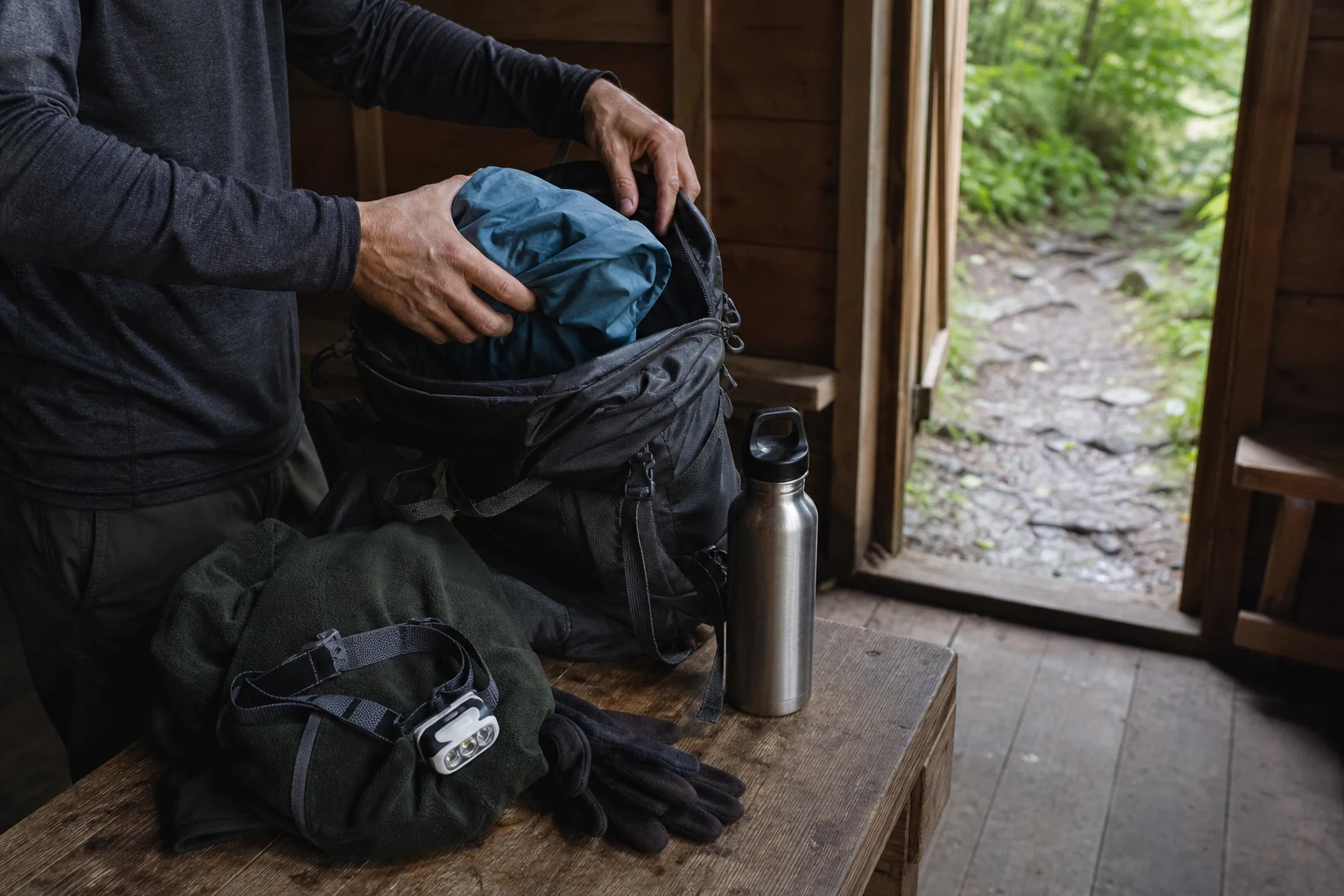
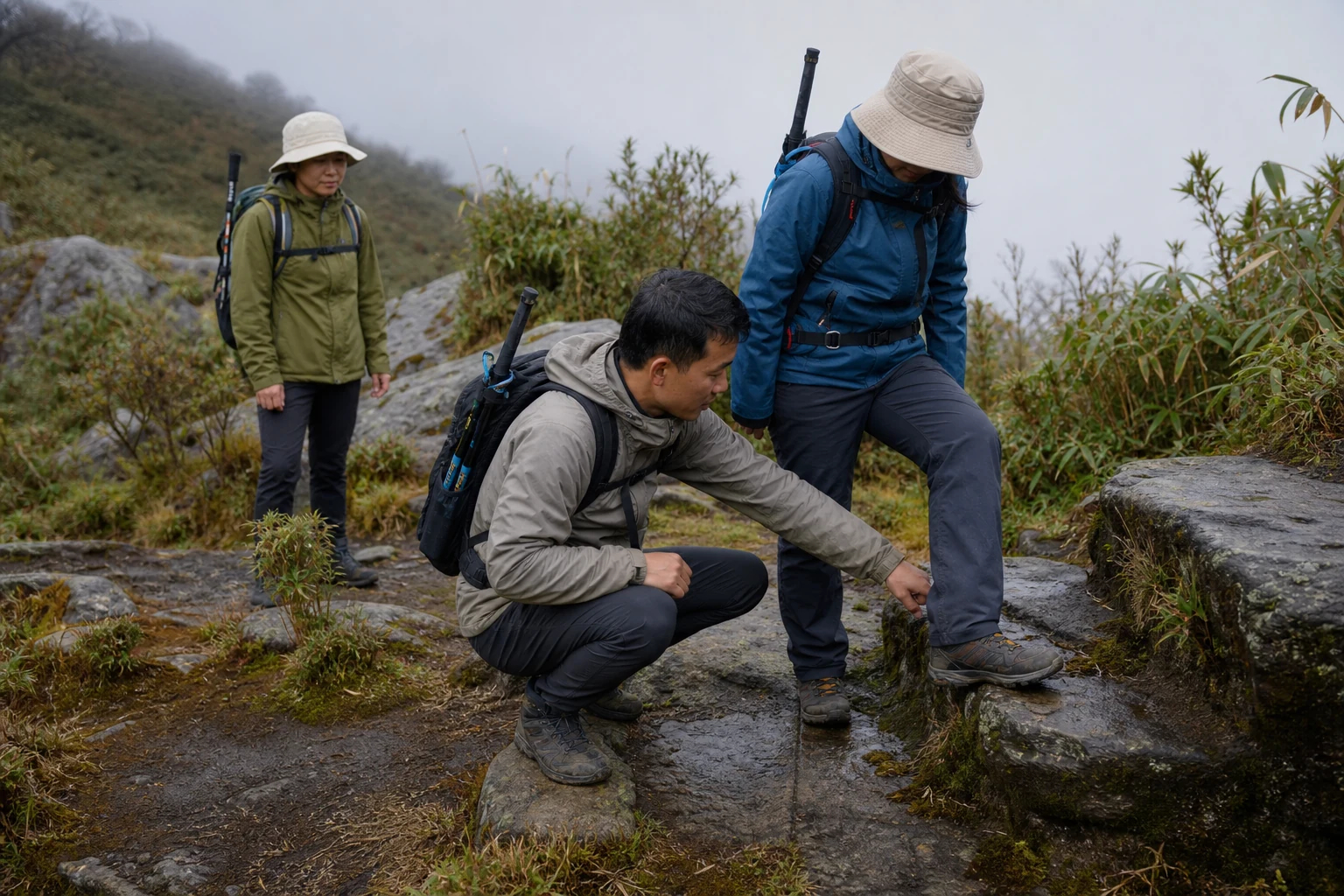
Warm hat, gloves, fleece and insulated jacket are required even in October. Thermal base layer for the lodge night. Waterproof boots with ankle support — the path is often wet underfoot. Headlamp with spare batteries for the pre-dawn summit walk; red-light mode preserves night vision.
Carry one point five to two litres capacity up on Day 1. Twenty-five to thirty litre daypack — layers, snacks, camera; no cotton above 2,000 m. Main luggage stays in town with our driver. Trekking poles are strongly recommended, especially on icy stone steps in January.
Lay out summit layers at the top of your pack before sleep so you are not searching in the dark at 05:30. Keep spare batteries in a jacket pocket, not buried in your pack.
- Packing for trekking in Ha Giang
Layering, footwear and daypack sizing for northern Vietnam.
Leaving the lodge before dawn.
The pre-dawn walk from lodge to ridge is twenty to thirty minutes on a narrow path — not the full Day 1 climb. You leave with headlamp, insulated layer and camera; breakfast stays in the pack until the group descends to a safe flat after sunrise.
The path crosses wind-exposed bamboo before the spine opens — gloves on before you leave the lodge, not at the ridge. If cloud is below you, the world shrinks to ten metres of beam; stay on the guide's heel and do not pass.
In December sunrise is near 06:45 — we leave the lodge around 05:30. Your guide may delay twenty minutes if foothill contacts report cloud base rising too fast overnight.
Why not sleep in town.
The one-day sunrise ridge solves the summit problem with a morning departure from Hoang Su Phi and a full daylight ascent from Ta Su Choong. The two-day cloud-sea programme trades that compressed day for a lodge night at Chieu Lau Thi 2402m Lodge and a twenty- to thirty-minute pre-dawn walk to the crest. Both reach 2,402 m; the lodge night changes how your body arrives at the ridge.
Sleeping high means you feel the massif cool after dusk — wind on the ridge, a simple lodge dinner, and cold rooms even with blankets provided in winter. That is not discomfort for its own sake; it gives your body a night to settle into the altitude before the summit push. Guests who only day-hike the massif often underestimate how different the ridge feels when you wake already on the mountain.
Main luggage stays in Hoang Su Phi with our driver on the two-day route. Your daypack carries warm layers, headlamp, water and camera — target under eight kilograms if you pack sensibly because porters carry group food and spare water to the lodge on Day 1.
When the lodge is closed.
We do not run this programme June through September — storm season on Tay Con Linh. The lodge supports cold-season walking when cloud inversions are most likely and lightning risk is lower. October through April is the operating window; inside the lodge, November to March often means cold rooms even with blankets provided.
Book after reading preparing for a two-day mountain trek if this is your first ridge walk in Ha Giang. Ban Phung terraces at lower elevation make a useful rest day between mountain programmes for guests chaining Hoang Su Phi walks.
Community fees from your booking support hamlet funds and lodge upkeep in Dao and Nung communes. The English-speaking lead guide handles town logistics; your local trail guide and porter set pace on steep ground and maintain the forest path.
- Best time to trek Ha Giang
Month-by-month conditions across the province.
Common questions.
How cold is the lodge?
Expect cold inside the lodge in winter months — thermals and full warm layers are essential. Beds and blankets are provided; wear thermals if you run cold. From November to February, expect freezing nights outside on exposed ridge walks.
What is the lodge like?
Overnight accommodation is at Chieu Lau Thi 2402m Lodge on the approach route near the summit. The property offers private rooms and dorm-style accommodation; your room type is confirmed when the departure is booked. Electricity for charging, bathroom facilities, usable phone signal and internet at the lodge, and meals are part of the programme — not a hotel or resort.
Is there phone signal?
Usable phone signal and internet access are available at Chieu Lau Thi 2402m Lodge — do not treat this as hotel Wi-Fi speed or as a substitute for mobile coverage on the trail or summit.
Can I leave my main bag in town?
Yes — it stays in Hoang Su Phi with our driver. You carry only a daypack to the lodge.
Read next before booking.
Preparing for a two-day mountain trek covers day-by-day rhythm and the demanding climb. Summit safety explains the final push and exposure on the crest. Photography on the ridge covers dawn settings and battery care in cold air.
If a mountain lodge overnight and pre-dawn summit walk feel like too much, compare the one-day sunrise ridge — same summit, different rhythm.
- Preparing for a two-day mountain trek
Day-by-day rhythm, kit and pacing for the lodge night.
- Summit approach and mountain safety
The final push to 2,402 m and guide safety calls.
- Photography on the Chieu Lau Thi ridge
Exposure, batteries and safe standing lines at dawn.
- Which Chieu Lau Thi programme to book: one day or two
Schedule, overnight rhythm and fitness — the calendar decision.
- Chieu Lau Thi — sunrise ridge (1 day)
Single demanding day — morning departure after breakfast, daylight ascent to the ridge, back in town by late afternoon.
Published by Ha Giang Trekking — field knowledge from local trail guides on the routes described, checked against programme schedules and operating notes.
Journal pages are for route research and planning. Dates, prices, day-by-day schedules and enquiry sit on programme and tour pages.
Articles are published under Ha Giang Trekking. Named writer and guide bylines will be added when verified bios and consent are on file.
Operational details on programme and tour pages are published only after being checked against current operating information.
Compare published routes and open the programme or journey page when you are ready to enquire.
- Ridge & Cloud — compare summit programmes
Compare difficulty, seasons and walking style before you enquire.
- Chieu Lau Thi — cloud sea (2 days)
Chieu Lau Thi — cloud sea (2 days) — dates, pricing and enquiry.
- Chieu Lau Thi — sunrise ridge (1 day)
Chieu Lau Thi — sunrise ridge (1 day) — dates, pricing and enquiry.
- Kieu Lieu Ti three-day traverse
Trekking operations on this route are currently unavailable, and we are not accepting bookings for it at present.
Trekking operations on this route are currently unavailable, and we are not accepting bookings for it at present.
- Chieu Lau Thi: A Complete Guide for Trekkers
Main walking guide for Chieu Lau Thi.
- Hoang Su Phi Rice Terraces: A Complete Guide for Trekkers
Landscape, seasons and routes around Hoang Su Phi.
- Tay Con Linh: A Complete Guide for Trekkers
Neighbouring walking country linked to Chieu Lau Thi.
Ready to walk with local guides?
Dates, pricing and the day-by-day itinerary are on the programme page. Enquire about a departure when you are ready — we usually reply within 24 hours with availability, a clear price and what to pack.
Chieu Lau Thi — cloud sea (2 days) — dates, pricing and itinerary