Terrace farming in Hoang Su Phi
Irrigation, harvest timing and footwork on the steepest planted walls — how rice is grown above 1,000 m in La Chi country.

Why Ban Phung counts as high terrace country.
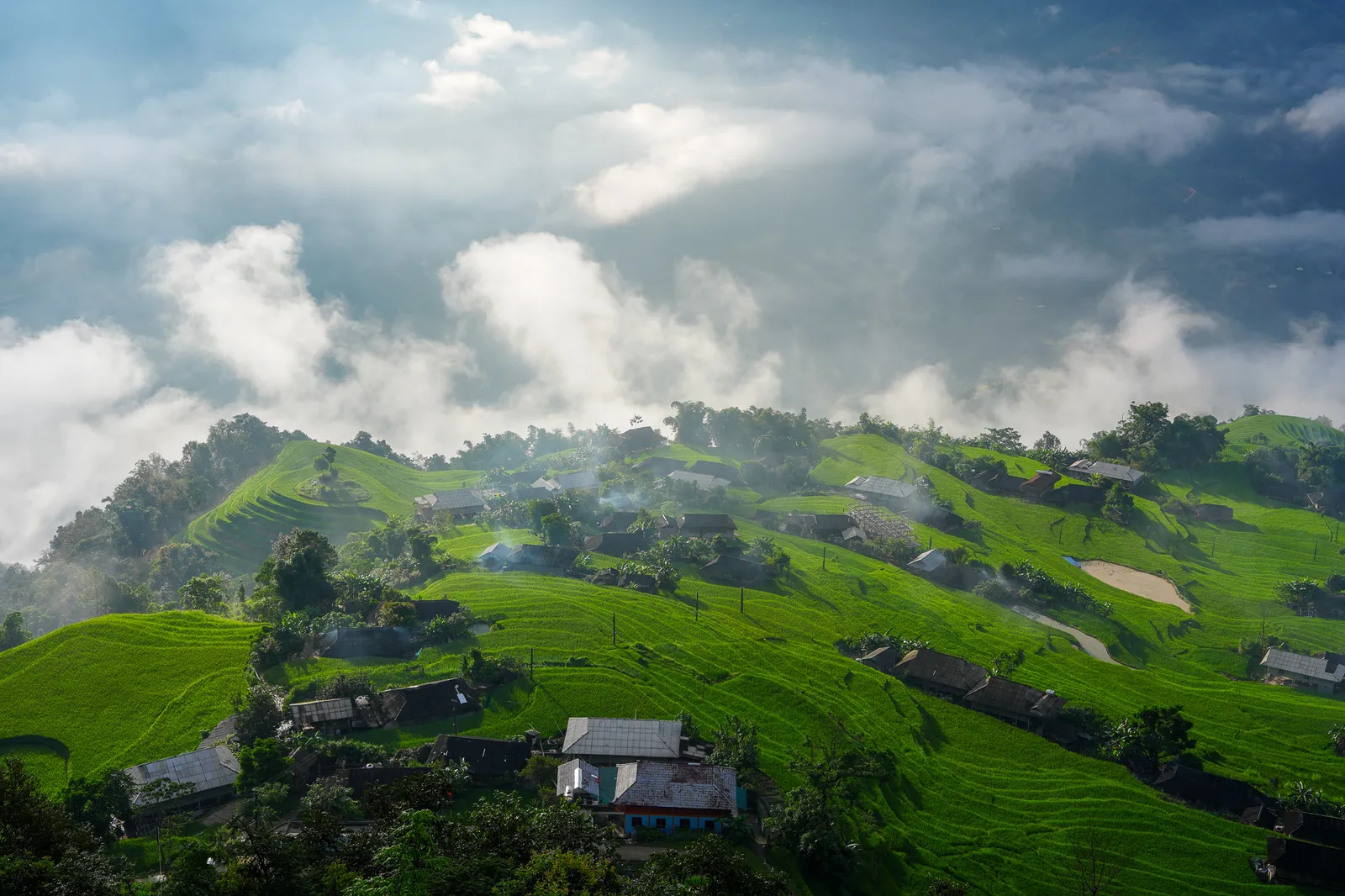
Ban Phung above the Chay river is among the highest planting country in Hoang Su Phi — paths cross irrigation channels and bamboo bridges that no vehicle reaches. La Chi farmers plant rice above 1,000 m on walls so steep the local phrase is 'climbing the sky.'
We describe the height claim as regional consensus among farmers, not a formal survey. What matters on the ground is the work: seed rice carried on backs, stone weirs maintained in dry weeks, harvest weeks when upper tiers turn gold a week after lower paddies.
The terrace circuit is an agricultural primer in one valley — irrigation, transplanting, harvest and tea on gentler slope — before longer routes like Nam Hong or Ban Luoc cross multiple livelihoods.
- Ban Phung highest terraces
- Hoang Su Phi destination hub
Compare routes, difficulty and seasons at this collection hub.
Springs, channels and shared weirs.
Terraces here are fed by upland springs and shared channels — the same water that fills planting pools in May runs in thinner streams by October harvest. Your guide can point out where La Chi families maintain stone weirs; those repairs happen in dry weeks, not during flooded planting.
Terrace irrigation channels look shallow but carry fast water after upland rain. Step over, do not through. Each wall has an inner drain — your guide walks the drain line when mud is deep because that is where farmers work, not on planted rows or wall caps.
Valley weather differs from the town forecast. Your guide checks with hamlet contacts the evening before and may adjust the start time if fog will delay views — the same contacts know whether upland rain will swell channels by midday.
- Trekking Ban Phung through the seasons
How rain changes footing, river crossing and pace.
Flooded paddies and transplanting.
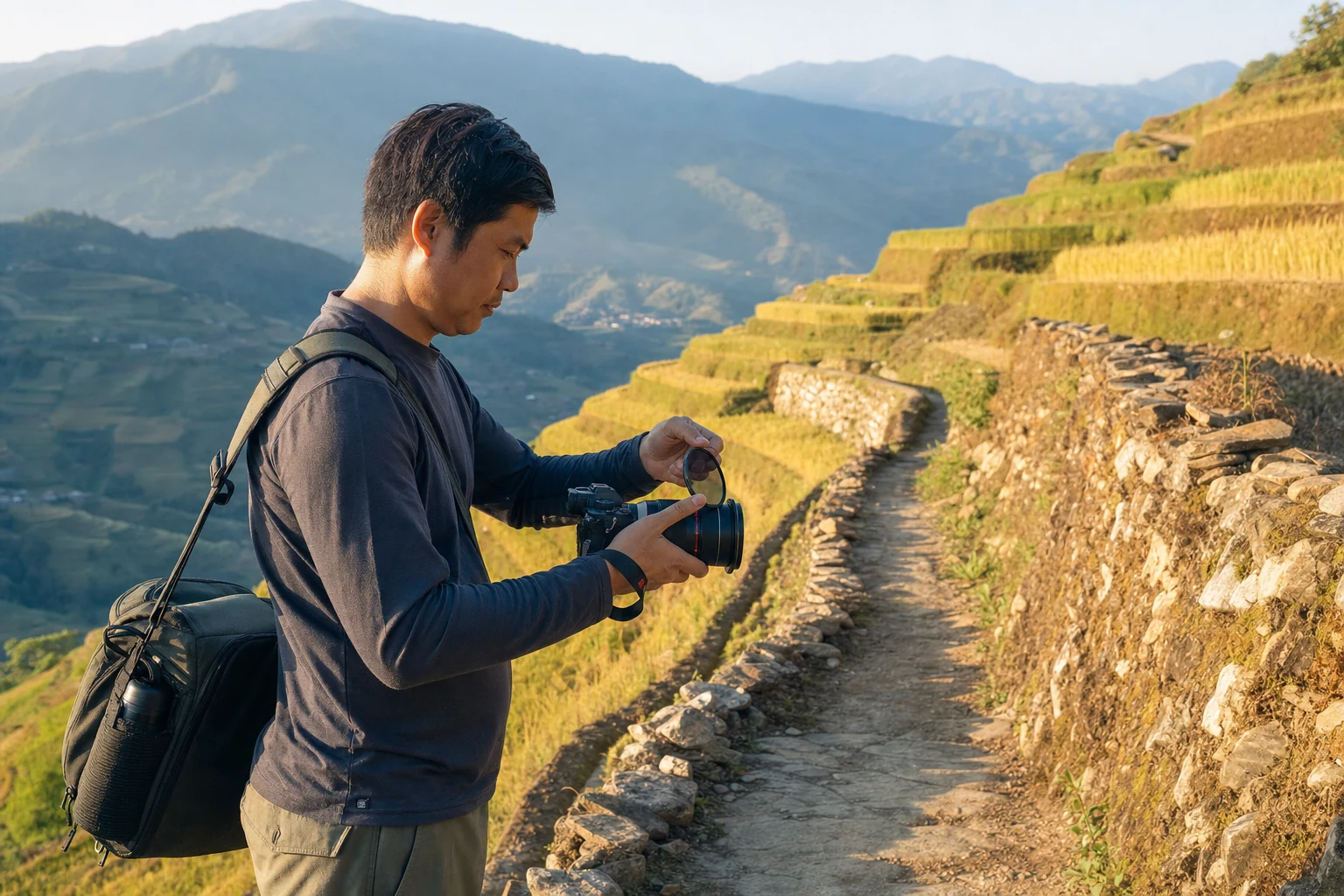
May and June hold flooded paddies at planting — mirror-still water between walls, hotter afternoons, fewer visitors on the walls. Green season photography favours 07:00–09:00 before wind ripples flooded paddies.
Footing in green season means slick clay and slower pace on walls. Polarising filters cut glare in May and June when standing water reflects sky between tiers.
- Photography guide to Ban Phung
Green-season light and reflection timing.
Harvest gold and field labour.
September and October are the classic months: harvest gold on the terraces, firm paths and clear morning light across the Chay valley. Mid-September through October in most terrace villages — exact timing varies by elevation; higher plots harvest later.
Harvest season vs green season
| Harvest (Sept – Oct) | Green / planting (May – Jun) | |
|---|---|---|
| Footing | Firmer wall edges; dry straw on steps | Slick clay; slower pace on walls |
| On the path | Farmers cutting; brief waits for basket trains | Quieter terraces at midday |
| Photography | Side-light first 90 min after sunrise | Reflections 07:00–09:00 before wind ripples water |
| Booking note | Upper tiers turn gold a week after lower paddies | Calm morning matters more than clear sky |
Footing
Harvest (Sept – Oct)
Firmer wall edges; dry straw on steps
Green / planting (May – Jun)
Slick clay; slower pace on walls
On the path
Harvest (Sept – Oct)
Farmers cutting; brief waits for basket trains
Green / planting (May – Jun)
Quieter terraces at midday
Photography
Harvest (Sept – Oct)
Side-light first 90 min after sunrise
Green / planting (May – Jun)
Reflections 07:00–09:00 before wind ripples water
Booking note
Harvest (Sept – Oct)
Upper tiers turn gold a week after lower paddies
Green / planting (May – Jun)
Calm morning matters more than clear sky
Harvest weeks bring dry straw on paths; slip risk shifts from clay to loose chaff on stone steps. Brief waits for basket trains are normal — guides call 'wait' when wide loads need the full wall width.
- When to trek Ha Giang, month by month
District-wide season patterns beyond Ban Phung.
Months on the walls.
- Nov – Feb · Cool mist; quiet paths; frost possible above 1,500 m on nearby ridges
- Mar – Apr · Silk-cotton flowers on forest edges; plum blossom above stone-walled villages
- May – Jun · Flooded planting pools; hotter afternoons
- Jul – Aug · Slippery steps; river may affect bamboo bridge
- Sept – Oct · Harvest gold; busiest booking weeks
Footwork on terrace walls.
Terrace paths are not uniform trail. Each wall has an outer lip, a planted tread and an inner drain. Short steps beat long strides. Wall tops are off limits; stop on flat sections between rows, not on stubble or channels.
On the steepest walls, some guides ask for one pole on the uphill side only — two poles on narrow banks can catch on stone caps. After heavy rain, some guests switch to poles for the descent only; we carry spare pairs in town if you ask at booking.
- Walking the highest rice terraces in Ban Phung
Full circuit and pace on farm paths.
- Ban Phung trekking — practical
Kit, poles and fitness for terrace days.
Tea gardens and terrace rice.
Tea gardens on the return loop use a different water regime — rain-fed bushes on gentler slope. Tay villages in Thong Nguyen work tea gardens on contours that would not hold flooded paddies. Seeing both crops on one circuit is why Ban Phung works as an agricultural primer before longer village routes.
Rice demands shared irrigation and back-breaking wall maintenance. Tea demands pruning cycles and shade management on slopes where rice walls would collapse. Your guide can point out the boundary where La Chi rice ends and Tay tea begins on the afternoon contour.
Ban Luoc Day 3 finishes on foot in Phin Ho — Shan Tuyet tea country — before vehicle transfer toward Tan Quang. The one-day Ban Phung loop samples Tay tea gardens on the afternoon return without that multi-day finish.
Walking through working fields.
Never step on planted rows or wall caps. When passing farmers, step to the uphill side. Community fees in your booking go to the hamlet fund before you walk. Guides check the bamboo bridge before every crossing; if the Chay is too high, the loop uses a contour that still reaches hamlet lunch.
We walk in light rain; in storms we shorten the loop and stay longer with the host family. Trail surface is dirt and stone steps on La Chi farm paths — slippery for 48 hours after rain. Guides know which sections have tree cover and which are exposed.
Pack out all litter — there is no collection on the loop. The terraces are not scenery — they are how families here still earn a living.
- How we work with communities
Community contributions and permits on village routes.
Terrace farming across the district.
Hoang Su Phi sits where the Red River gorge meets the Tay Con Linh massif. West of town, the Chay river cuts through La Chi terrace country. East and north, ridges climb through bamboo, rhododendron and cardamom forest toward Chieu Lau Thi at 2,402 m.
Seasonally, the landscape shifts from flooded mirror terraces in May and June to harvest gold in September and October, then to bare stone and woodsmoke in the cold months. Ban Phung concentrates the steepest rice walls in one day; Ban Luoc adds Black Dao and Tay valleys across three days.
Many guests walk Ban Phung first, then Nam Hong–Ho Thau or Ban Luoc. We help sequence dates when you enquire — harvest weeks in October fill quickly, and homestay beds in Nam Hong and Ban Phung are shared across programmes.
What farmers carry on the walls.
During transplanting, seedling trays move downhill to flooded paddies — give way to anyone carrying load on the same walls you walk. Harvest weeks bring sickles, bundled straw and basket trains that need the full width of a terrace lip; guides call 'wait' so you step to the uphill side.
Stone weir repairs happen in dry weeks when channels run low — not during flooded planting. Your guide can point out fresh mortar or replaced capstones where a family fixed irrigation before the next monsoon.
If you walk in cold months, fewer people work the walls but woodsmoke and stored rice in stilt houses show last season's yield. The agricultural story is still visible — bare stubble, drained channels, tea pruning on the afternoon loop — even when the terraces are quiet.
Elevation spread across the district.
The terrace circuit stays between roughly 900 and 1,300 m — warm afternoons on open walls, no cold ridge nights. Hoang Su Phi elevation ranges from about 700 m in river valleys to above 2,400 m on Chieu Lau Thi; Ban Phung shows the upper end of rice planting, not the summit zone.
Weather changes quickly across that spread — warm terraces below, cold nights above 1,500 m on Nam Hong or Chieu Lau Thi. Fog can lift or settle within an hour. Valley weather on the Chay differs from the town forecast; hamlet contacts inform start times, not apps alone.
Choosing Ban Phung first keeps luggage in town and tests legs on uneven ground before you commit to Ban Luoc Day 2 or a Tay Con Linh ridge. The farming detail you learn here — water, footwork, harvest timing — applies when you later cross into La Chi Ban Phung from the traverse with tired legs.
- Ban Phung trekking — practical
Fitness, route choice and programme sequencing.
Common questions.
When is the rice harvest in Ban Phung?
Mid-September through October in most terrace villages. Higher plots harvest later — upper tiers often turn gold about a week after lower paddies.
Can I walk during planting season?
Yes. May and June offer flooded paddies and fewer visitors. Footing is slicker and pace is slower; guides adjust rest stops accordingly.
Are farmers working on the path every day?
On weekdays you often share walls with farmers carrying seed rice or harvest loads. Harvest weeks are busiest; cold months are quieter on the terraces.
Do I need to know farming to enjoy the walk?
No. Your La Chi guide explains irrigation, transplanting and harvest as you walk. The circuit is designed so observation teaches — you do not need prior agricultural knowledge.
Published by Ha Giang Trekking — field knowledge from local trail guides on the routes described, checked against programme schedules and operating notes.
Journal pages are for route research and planning. Dates, prices, day-by-day schedules and enquiry sit on programme and tour pages.
Articles are published under Ha Giang Trekking. Named writer and guide bylines will be added when verified bios and consent are on file.
Operational details on programme and tour pages are published only after being checked against current operating information.
Ready to walk with local guides?
Dates, pricing and the day-by-day itinerary are on the programme page. Enquire about a departure when you are ready — we usually reply within 24 hours with availability, a clear price and what to pack.
Ban Phung — highest terraces (1 day) — dates, pricing and itinerary