Seasons, packing and route choice for Ban Luoc
Harvest windows, daypack vs main bag, and when to choose the one-day Ban Phung walk instead.
Seasons, packing and route choice.
Seasonal windows and kit for the Ban Luoc traverse — when paths firm up, when harvest fills beds, and what to carry in a daypack versus main bag. For landscape context and route choice, read the Ban Luoc trekking guide first.
Day-by-day schedule, includes and enquiry live on the long traverse programme — this article covers seasons and packing only, not booking logistics.
Plan to arrive in Hoang Su Phi town the day before Day 1. Private transfer to the Ban Luoc walking start is included on the programme.
- Ban Luoc — the long traverse (3 days)
Full programme page with day-by-day schedule, pricing and enquiry via Contact.
- Ban Luoc trekking guide
Landscape, seasons and route choice — research before you book.
- Hoang Su Phi programme hub
Compare routes, difficulty and seasons at this collection hub.
September and October.
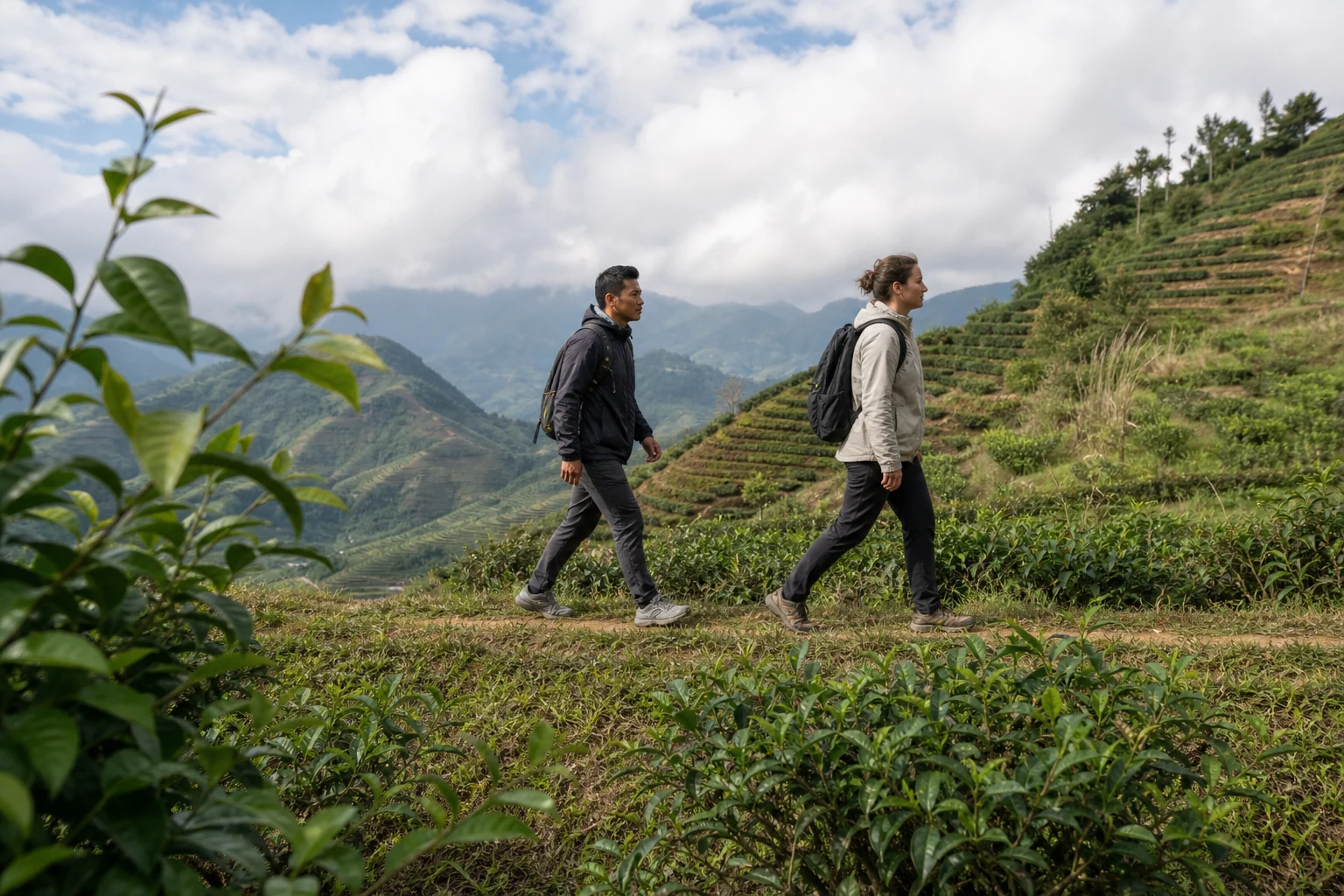
September and October are the classic months — harvest gold on terraces, firmer paths, clearer ridge views. Busiest weeks — we keep groups small. Book early for October; beds across Hoang Su Phi programmes fill quickly.
October is generally dry — we monitor weather daily and re-route around any unsafe section.
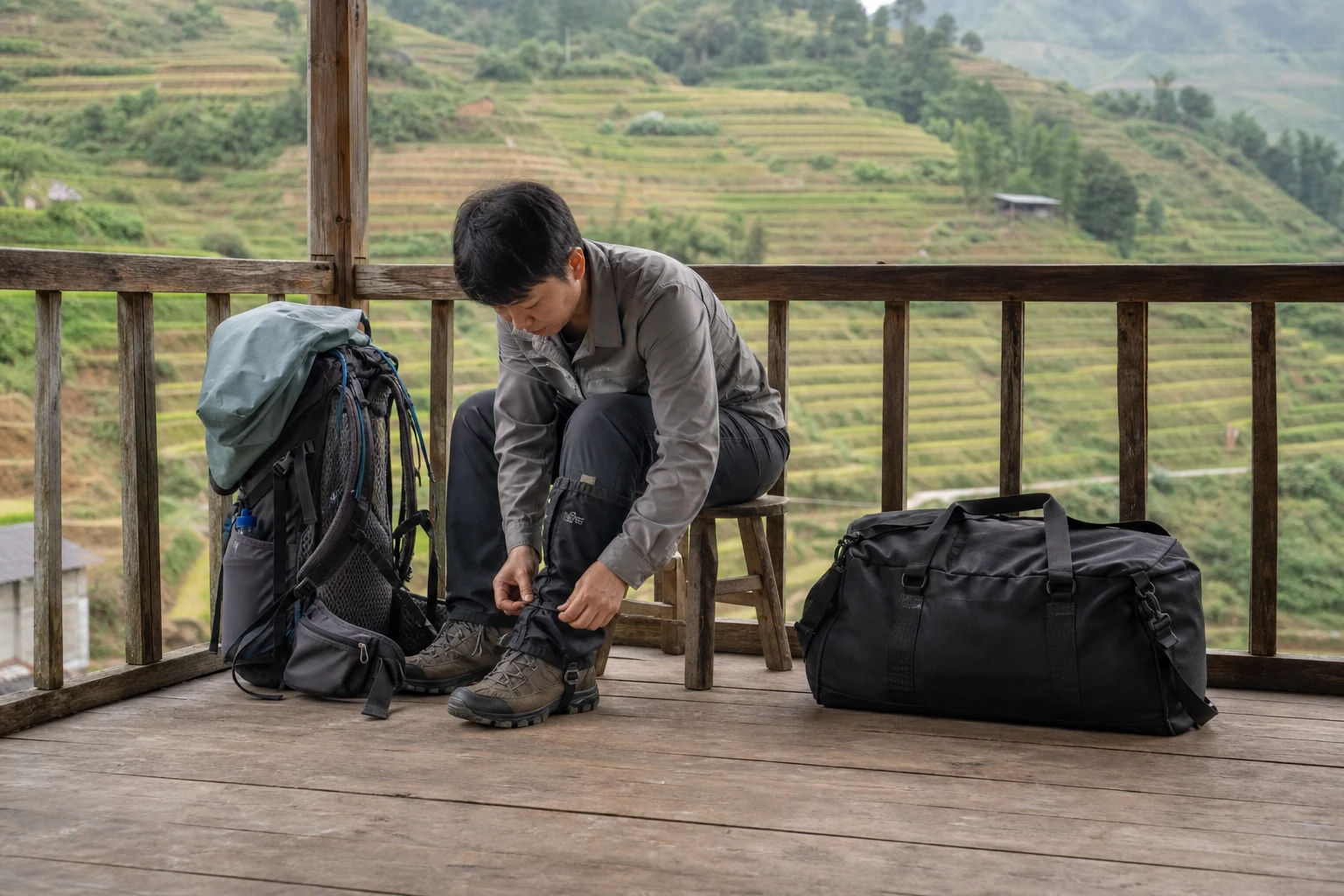
Gaiters earn their weight on village paths during harvest foot traffic — livestock, dust, mud after occasional rain.
- Best time to trek Ha Giang
Month-by-month across the province.
March through May.
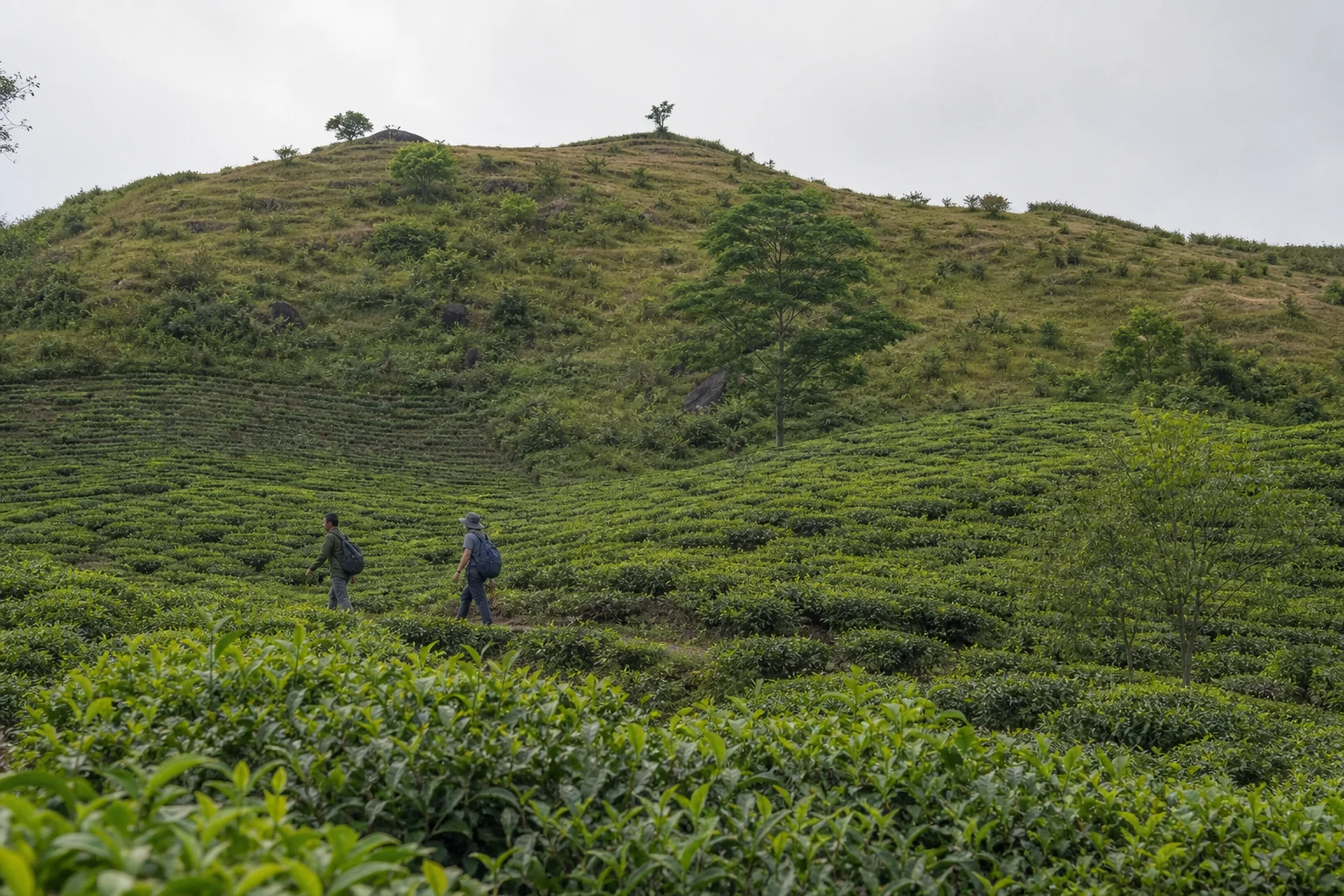
March and April add flowers on forest margins and plum blossom above stone-walled villages. May and June hold green paddies — luminous terraces, warmer afternoons, slicker clay on consecutive walking days. Ideal for Nam Hong–Ho Thau and village stays; Ban Luoc runs with heat-adjusted pacing.
Rain shell essential in shoulder season. Sun protection and two litres water capacity matter more in May and June than in October.
November brings mist on ridges — atmospheric, slower photography, cooler overnight stops.
- Ban Luoc — the long traverse (3 days)
Full programme page with day-by-day schedule, pricing and enquiry via Contact.
Monsoon and cold months.
July and August — daily rain, luminous terraces, slippery stone steps. We monitor Day 2 descents closely. Tay Con Linh summit routes do not run in storm season; Ban Luoc terrace traverse may still run with timing adjustments.
November through February — frost possible on higher highland nights, woodsmoke, clear mornings, empty trails. Pack warm layers for overnight stops. Cold clarity suits walkers who accept mist risk over harvest gold.
Is the route safe in October rains? October is generally dry. Shoulder-season clay is why broken-in boots and gaiters are on the list.
- Ban Luoc — the long traverse (3 days)
Full programme page with day-by-day schedule, pricing and enquiry via Contact.
Packing for three days.
- 25–30 L daypack — layers, water, camera; main bag for motorbike transfer
- Two trail outfits + warm layer for highland overnight stops
- Rain shell; gaiters in shoulder season for clay on Day 2
- Headlamp, quick-dry towel, modest sleepwear, toiletries
- Trekking poles — recommended on wet or rooty sections
- Sturdy trekking shoes, broken in — blisters on Day 1 ruin Day 2
- Packing for Ha Giang
Province-wide trekking kit.
- Recovery pacing
How kit choices affect Day 2.
Before you go.
Label main bag clearly — same family name on transfer days. Cash for tips at overnight stops and driver network. Travel insurance covering multi-day trekking. Tell us about knee or ankle history at booking — guides adjust pace.
Broken-in boots essential. Confirm pickup in Hoang Su Phi town the day before. Maximum group size eight trekkers.
September–October harvest weeks fill quickly. If dates are fixed, book Ban Luoc before add-on day walks.
- Ban Luoc — the long traverse (3 days)
Full programme page with day-by-day schedule, pricing and enquiry via Contact.
Traverse vs one day.
Ban Luoc (3 days) — western Ho Thau, Nam Ai, Phin Ho corridor, approx. 49 km trekking, two standard overnights, daypack plus transferred main bag. Best for committed walkers after a shorter Hoang Su Phi route.
Ban Phung (1 day) — one La Chi valley, lunch only, full-day terrace walk, daypack only, hardest section morning descent and hamlet climb. Best for first Hoang Su Phi introduction.
Nam Hong (2 days) — Nam Ai or Phin Ho overnight, Moderate — best if two days fit your calendar and you want cultural depth without a third long walking day.
- Ban Phung — highest terraces (1 day)
One-day La Chi terrace walk — a separate valley from the Ban Luoc western traverse.
- Nam Hong to Ho Thau (2 days)
The two-day Red Dao crossing — a different corridor from the Ban Luoc → Ho Thau → Nam Ai → Phin Ho traverse.
- Ban Luoc — the long traverse (3 days)
Full programme page with day-by-day schedule, pricing and enquiry via Contact.
Hoang Su Phi highland weather.
The district sits where the Red River gorge meets the Tay Con Linh massif. Weather changes quickly: warm afternoons in terraces, cooler nights at highland overnights, fog that lifts or settles within an hour on the Day 1 walk.
Seasonally, the landscape shifts from flooded mirror terraces in May and June to harvest gold in September and October, then bare stone and woodsmoke in cold months. March and April bring plum blossom above stone-walled villages — flower margins on Day 1 forest paths reward macro lenses without adding kilometres.
Choosing when to walk is choosing which version of the same path you want — green mirror, harvest gold, or cold clarity with mist risk.
- Hoang Su Phi programme hub
Compare routes, difficulty and seasons at this collection hub.
After Ban Luoc — Chieu Lau Thi.
Many guests rest in town, then book Chieu Lau Thi cloud sea for altitude contrast — lodge night at Chieu Lau Thi 2402m Lodge, 2,402 m summit dawn, cold weather kit entirely different from Ban Luoc overnight stops. Allow one rest day between programmes.
Ban Luoc is terrace-and-village country; Chieu Lau Thi is ridge-and-cold country. Sequencing them back-to-back without rest is how knees and sleep debt compound.
Village treks collection on the site groups homestay routes; ridge-cloud collection groups altitude programmes — use hub comparison before stacking bookings.
- Hoang Su Phi programme hub
Compare routes, difficulty and seasons at this collection hub.
Hoang Su Phi town before trek.
Arrive town the day before Day 1 — ATMs, last-minute snacks, rain shell purchase if forgotten. Confirm pickup point with guide the evening before. Cash for tips is easier in town than on trail.
Sunday market in town when dates align offers district context before village walking — not required but useful for understanding what hosts trade and grow.
Hotel before and after trek is excluded from programme price — book town accommodation when you book flights; harvest weeks fill local guesthouses too.
- Hoang Su Phi programme hub
Compare routes, difficulty and seasons at this collection hub.
Training before you go.
Walk hilly terrain regularly for four to six weeks before Ban Luoc — practice with a 25–30 L daypack loaded with water and layers similar to trail weight. Day 2 is not the day to discover your boots rub or your shoulders fatigue under pack straps.
Trekking poles: borrow or bring if you use them on descents at home. Broken-in boots are non-negotiable — trail shoes without grip are a poor choice on wet clay.
Travel insurance covering multi-day trekking should name hiking or trekking activities explicitly. Inform us of medical conditions at booking — guides carry emergency protocol but prevention starts with honest fitness disclosure.
- Ban Luoc — the long traverse (3 days)
Full programme page with day-by-day schedule, pricing and enquiry via Contact.
What to walk next.
Many guests rest a day after Ban Luoc, then book Chieu Lau Thi cloud sea or village programmes in another district. Ban Luoc completes the western terrace-and-village story — ridge programmes are the usual altitude step up.
Guests often combine Nam Hong first, then Ban Luoc, or add Ban Phung as a photography day after the traverse. We sequence dates when you enquire.
Allow a rest night after the traverse before another demanding walk.
- Three-day traverse overview
Full route rhythm and fitness.
What price excludes.
Transfers outside Hoang Su Phi district except the arranged Phin Ho → Tan Quang vehicle, hotel before and after trek, alcoholic beverages, optional Phin Ho overnight, sleeper-bus tickets unless quoted, tips for guides drivers and host families, personal expenses — all excluded from the quoted traverse from-price unless confirmed in writing.
Travel insurance for transit to Ha Giang is separate from trekking accident cover included in the programme. Budget cash tips across two standard overnight stops and the driver network.
Alcohol is personal cost — dehydration before Day 2 is a performance issue, not a billing issue.
- Ban Luoc — the long traverse (3 days)
Full programme page with day-by-day schedule, pricing and enquiry via Contact.
Around US$ 295 per person.
Around US$ 295 per person is an approximate reference for the private programme — three days of guides, two standard overnight nights, motorbike luggage network, meals, permits, insurance and community payments — not a volume discount tour. Final quotation varies by party size, dates, logistics, and confirmed services.
Group size two to eight — below minimum, enquire with your dates for pairing. Above maximum, we split across dates to protect paths and overnight floors.
Tips excluded — budget cash for two standard overnight households and drivers across transfer days.
- Ban Luoc — the long traverse (3 days)
Full programme page with day-by-day schedule, pricing and enquiry via Contact.
Common questions.
What is the group size?
Two to eight trekkers. Smaller groups are easier to pace on Day 2.
Do I need a visa beyond standard Vietnam entry?
Standard Vietnam entry requirements apply. Permits and community contributions are included in the programme.
Can I rent gear locally?
Trekking poles can be lent if you ask when you enquire. Boots and rain gear should be your own, broken in.
When should I book?
September–October harvest: as early as possible. March–May and November: two to four weeks ahead is usually sufficient.
Published by Ha Giang Trekking — field knowledge from local trail guides on the routes described, checked against programme schedules and operating notes.
Journal pages are for route research and planning. Dates, prices, day-by-day schedules and enquiry sit on programme and tour pages.
Articles are published under Ha Giang Trekking. Named writer and guide bylines will be added when verified bios and consent are on file.
Operational details on programme and tour pages are published only after being checked against current operating information.
Ready to walk with local guides?
Dates, pricing and the day-by-day itinerary are on the programme page. Enquire about a departure when you are ready — we usually reply within 24 hours with availability, a clear price and what to pack.
Ban Luoc — the long traverse (3 days) — dates, pricing and itinerary