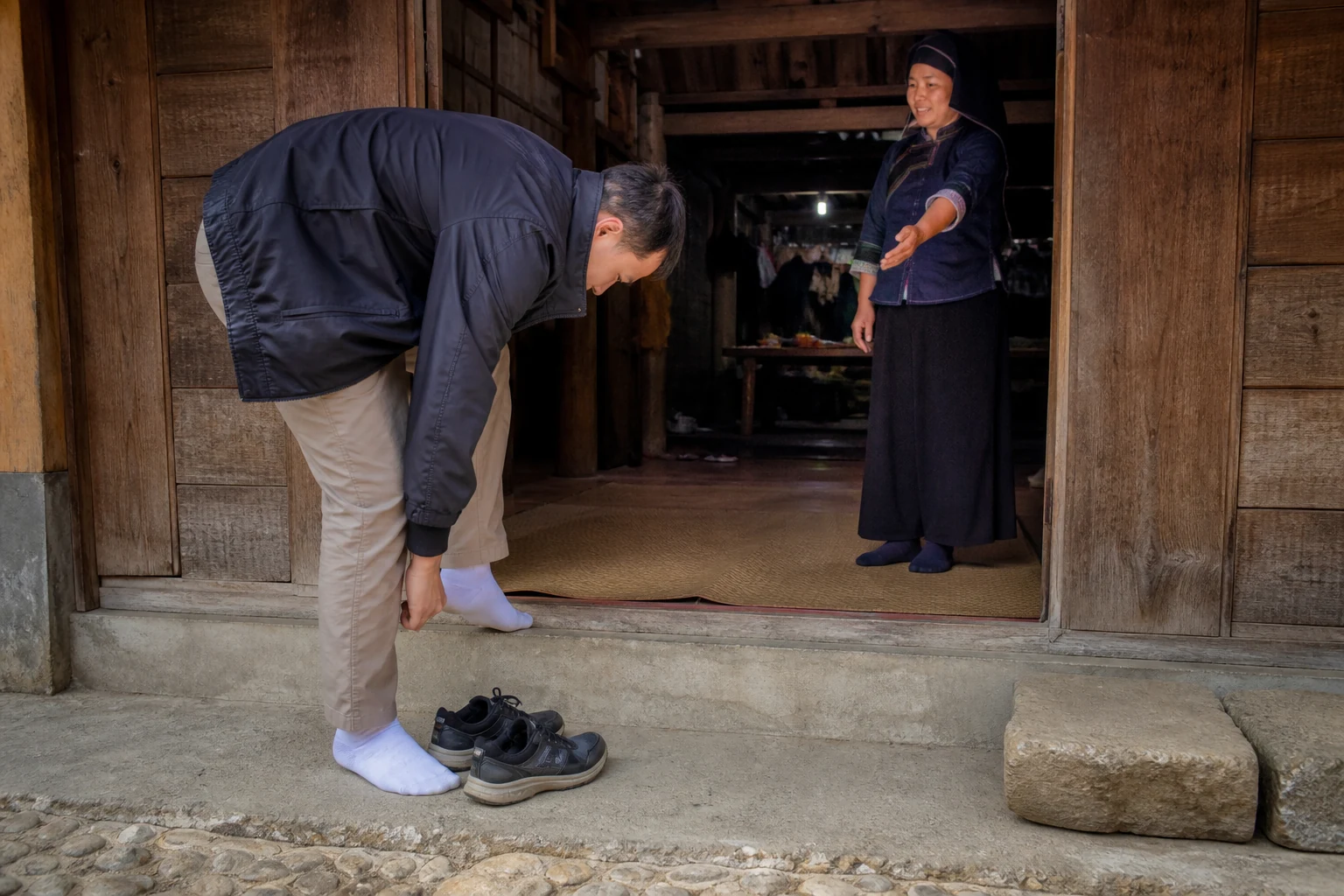
The Sunday markets of the far north
Where five ethnic groups meet, trade, and tell stories that have travelled for centuries.

Sunday markets of the far north.
The markets of Ha Giang are not tourist stops. They are the social and economic heartbeat of the plateau — and they rotate, village by village, day by day, in a centuries-old rhythm.
Sunday markets at Meo Vac and Dong Van are reachable by road. Smaller commune markets, which your guide can identify, are where trade still happens on foot.
This guide covers the two Sunday markets most guests encounter on the Dong Van loop, the lunar-cycle exception at Lung Phin, and how to visit without treating ethnic dress as a backdrop. For Meo Vac district trekking context — tours, canyon access and valley closes — read the Meo Vac trekking guide.
- Village treks hub
Compare routes, difficulty and seasons at this collection hub.
- Meo Vac trekking guide
District trekking owner — tours and canyon access.
- Eating with the Hmong
Thang co, men men and market rice wine.
Meo Vac on Sunday.
Meo Vac on Sunday is the largest. Hmong, Tay, Dao, Lo Lo and Giay traders arrive on foot, by motorbike and leading water buffalo down from the surrounding hills. By 7am, the livestock section is already loud.
Textiles, tools, produce and meat share the same muddy lanes. Thang co cauldrons steam early, while fresh greens and indigo cloth appear on tarpaulins. This is where five ethnic groups meet without a schedule printed for visitors.
If your trek ends near Meo Vac or you drive the loop anticlockwise, treat Sunday morning as a dawn commitment, not a brunch stop.
Dong Van: smaller, slower.
Dong Van is Sunday too, smaller and slower. The old quarter fills later; traders know each other by name. Lo Lo Chai to Then Pa finishes with pickup toward Dong Van town — if your dates align, ask whether Day 2 lunch can flex for an early market walk.
Photography here rewards patience — a weaver adjusting indigo thread, buffalo calves nudging through the crowd, not a posed costume line.
Foreign travellers need the Ha Giang province entry permit for the northern plateau — passport checks apply on loop routes; market day does not exempt paperwork.
- Lo Lo Chai to Then Pa
Finishes near Dong Van — flagpole timing on Day 2.
Lung Phin and the calendar.
Lung Phin runs on dog-and-dragon days in the lunar calendar. Ask a local guide to translate: no two weeks line up with a simple Sunday rule.
Hoang Su Phi district has its own rotating commune markets, which exist for trade rather than tourists. A Sunday in Hoang Su Phi town is a good introduction before you walk out to Ban Phung or Nam Hong.
If market day is non-negotiable for your trip, send your full date range at enquiry. We match walking days to the nearest active market when logistics allow — not every programme passes a large Sunday market on foot.
- Hoang Su Phi hub
Compare routes, difficulty and seasons at this collection hub.
Textiles, produce and livestock.
Indigo cloth at Lung Tam cooperative is a working workshop visited on Nam Dam Day 3 — Monday to Saturday, looms running six days a week since 2001. Sunday plateau markets sell household textiles trader-to-trader, not demo looms.
Livestock sections are loud and real — water buffalo, pigs, poultry. Keep distance unless a trader invites you closer; photos of animals tied for sale need the same consent as portraits.
Produce is for locals first — prices are not souvenir-negotiation theatre. Buy what you will use; haggling over a bag of greens is poor form.
- Nam Dam to Lung Tam
Lung Tam indigo cooperative on Day 3 — weekday visit.
Market eating and rice wine.
Thang co simmers in the large cauldrons — horse meat and offal with cardamom and mountain herbs. Men men and corn dishes appear at simpler stalls. Eat standing if that is how the crowd eats.
Rice wine rounds start as the market thins. One cup with a vendor you bought from is enough unless you have no walking left that day.
Du Gia and Hoang Su Phi programmes include hosted lunches in villages — market food complements trekking days; it does not replace the homestay table.
Trekking connections and loop timing.
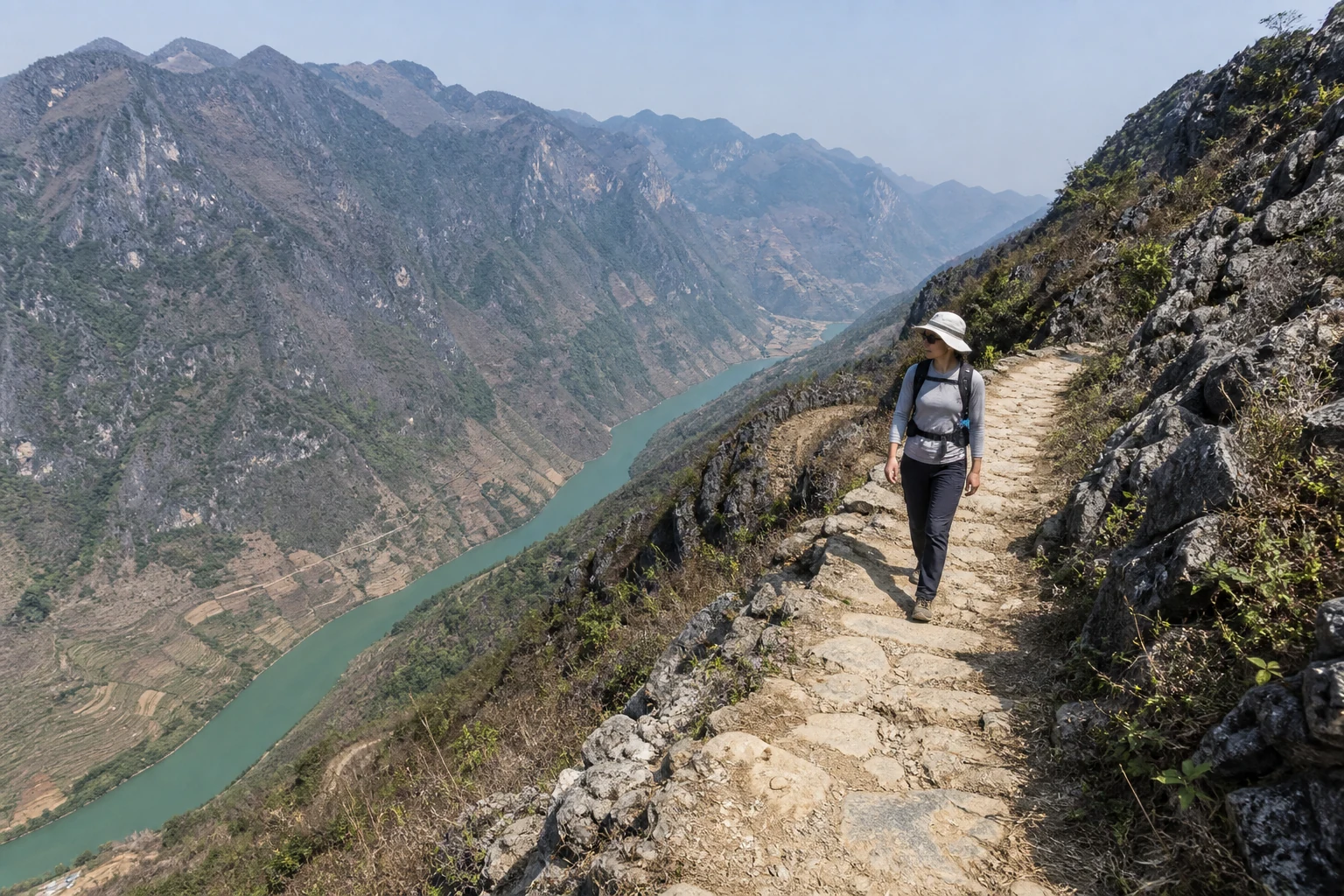
Most market visitors arrive by motorbike or car on the Dong Van loop. Our programmes use footpaths that connect villages. Meo Vac market is road-accessible, while smaller commune markets may sit on a ridge path your trek crosses with luck and timing.
Du Gia pairs naturally with a southern loop extension after Meo Vac. Tell us your wider itinerary when you enquire so driving days sit after walking days, not before a 6 – 7 hour ridge.
Parking and crowd density peak 8 – 10am Sunday. Rain does not cancel markets; mud makes livestock lanes harder — wear shoes with grip, not loop-road sandals.
Why markets still matter.
Ha Giang holds more than twenty ethnic groups. Markets are where Hmong corn from the ridge meets Tay rice from the valley, where Dao herbalists trade dried roots, where Lo Lo traders from mud-walled villages buy steel tools.
Tourism has not replaced this function — coach groups at Dong Van are visible, but the buffalo section at Meo Vac is still commerce, not show.
Walking in at foot pace — Lo Lo Chai at dusk, Nam Dam herbal gardens — gives context for what you see traded on Sunday: the same corn, cloth and medicine grown on paths you walked.
Visitor mistakes at market.
Arriving at 11am expecting full stalls and empty wine cups — the market is already packing.
Touching indigo cloth with sunscreened hands — dye stains and disrespect in one gesture.
Assuming every ethnic group trades every Sunday at one address — rotation is the system.
Permits, cash and timing.
Foreign travellers need the Ha Giang province entry permit for the Dong Van plateau loop. Passport checks apply whether you drive or walk in. Market day does not simplify paperwork, so carry passport and permit copies in a dry bag separate from your main pack.
Most guests reach Meo Vac or Dong Van by private car or motorbike from Ha Giang city; allow ninety minutes to two hours on winding roads. If your trek finishes near Dong Van on a Saturday, ask at enquiry whether an early Sunday market visit fits before pickup. Lo Lo Chai to Then Pa can flex Day 2 lunch timing when guides know market morning is a priority.
Cash in small notes is essential: produce, indigo cloth, tea and snacks rarely take cards. ATMs exist in Dong Van and Ha Giang town but not at market gates. Change runs out by mid-morning on busy Sundays, so withdraw the night before.
Dress for mud and livestock lanes — closed shoes, not sandals; a light rain shell if monsoon squalls move through the karst. Sun hat and water bottle even in cool months; market lanes have little shade once the livestock section fills.
- Lo Lo Chai to Then Pa
Finishes near Dong Van — ask about Sunday market timing on Day 2.
Common questions.
Which Sunday market should I prioritise?
Meo Vac for scale and ethnic mix; Dong Van for a slower walk through the old quarter. Ask your guide about Lung Phin if your dates include a dog-or-dragon day.
Can my trek include a market morning?
Sometimes — depends on route, day of week and lunar calendar. Send full dates at enquiry.
Do I need cash?
Yes. Small notes for produce, cloth and tea. Cards are rare on the plateau.
Is haggling expected?
For textiles and tools, mild negotiation is normal. For food and small produce, pay the asked price.
Are markets safe for solo travellers?
Busy and generally safe in daylight. Stay with your guide on first visit — livestock lanes and motorbikes share narrow space.
Go early, trade honestly.
A Sunday market on the Ha Giang plateau is still a market — loud, muddy, generous with smell and colour. Treat it as a morning of listening, not an afternoon of content.
Pair market day with a village trek before or after so you know what the traders grew on the path. Tell us your dates and we map the closest commune market to your walking programme.
- Village treks hub
Compare routes, difficulty and seasons at this collection hub.
- Eating with the Hmong
- Best time to trek Ha Giang
Published by Ha Giang Trekking — field knowledge from local trail guides on the routes described, checked against programme schedules and operating notes.
Journal pages are for route research and planning. Dates, prices, day-by-day schedules and enquiry sit on programme and tour pages.
Articles are published under Ha Giang Trekking. Named writer and guide bylines will be added when verified bios and consent are on file.
Operational details on programme and tour pages are published only after being checked against current operating information.
Compare published routes and open the programme or journey page when you are ready to enquire.
- Extended journeys — multi-day loops
Compare difficulty, seasons and walking style before you enquire.
- Private Hoang Su Phi to Dong Van Hiking Journey
Private Hoang Su Phi to Dong Van Hiking Journey — full itinerary and enquiry.
- Dong Van Karst Traverse
Dong Van Karst Traverse — full itinerary and enquiry.
- Ma Pi Leng Canyon Expedition
Ma Pi Leng Canyon Expedition — full itinerary and enquiry.
- Lung Cu Northern Frontier
Lung Cu Northern Frontier — full itinerary and enquiry.
- Meo Vac trekking guide: villages, markets and Ma Pi Leng access
Main walking guide for Meo Vac.
- Dong Van Karst Plateau: A Practical Guide for Trekkers
Neighbouring walking country linked to Meo Vac.
- Trekking Ma Pi Leng: What to Expect on Foot
Neighbouring walking country linked to Meo Vac.
- Lo Lo Chai to Then Pa — booking and fitness
Neighbouring walking country linked to Meo Vac.