Eating with the Hmong: a slow guide to mountain food
Thang co, men men, and the rituals of a shared table on the karst plateau.

Eating with the Hmong: mountain food, honestly.
Hmong food is not restaurant food. It is kitchen, market and festival food — built from what the mountains give and what the household has stored.
On our village routes, you eat with White Hmong families on the Ma Lung ridge, at Then Pa and in Nam Dam Day 2 homestays. Above Du Gia, Hmong hamlets grow corn and cassava on steep slopes while Tay villages farm rice below. The table reflects altitude and season, not a fixed tourist menu.
This guide covers everyday staples, market dishes, homestay dinners and rice wine — what to expect, how to behave, and what your guide handles for you.
- Village treks hub
Compare routes, difficulty and seasons at this collection hub.
- Homestay etiquette
Shoes, hearth and the shared table.
Men men: the taste of the high karst.
Men men is the everyday staple: steamed cornmeal, dry and crumbly, eaten with a thin broth and pickled greens. It is the taste of the high karst, where rice does not grow easily and corn does.
You meet it on ridge picnics and in households where corn is the reliable crop. It fills the bowl without ceremony — unlike sticky rice at a Tay lunch or the five-spice chicken at a Dao hamlet on the Du Gia circuit.
Do not expect wheat bread or soft rice every meal on a Hmong homestay night. Corn appears as cakes on the trail, as porridge at breakfast, and as the base of the evening table alongside mountain greens.
Thang co: the cauldron dish.
Thang co is the famous one — a long-simmered stew of horse meat and offal, perfumed with cardamom and mountain herbs. It is a market dish, traditionally cooked in huge cauldrons and shared standing up over rice wine.
Meo Vac on Sunday is the largest market on the plateau — Hmong, Tay, Dao, Lo Lo and Giay traders. Thang co appears there in the morning, before the wine comes out at midday. Dong Van on Sunday is smaller and slower; the same dishes, less volume.
Tourist cafés on the loop road sometimes serve a mild version. The market cauldrons are stronger in smell and texture. Your guide can steer you toward a stall or suggest you skip it if offal is not for you — no judgement either way.
- Sunday markets of the far north
Meo Vac, Dong Van and the lunar cycle markets.
The homestay dinner table.
Lo Lo Chai to Then Pa Night 1 is a White Hmong homestay below the Lung Cu flagpole. Family dinner is a shared table — corn, mountain greens, smoked pork, rice wine. Breakfast is sticky rice with peanuts and sweet tea before the descent to Then Pa.
Nam Dam to Lung Tam Night 2 lands in a White Hmong hamlet after the long ridge day — smoked pork, soup, rice, whatever the household dried or grew. Night 1 is Dao Cham, not Hmong, but Day 2 is when Hmong hosting rhythm takes over.
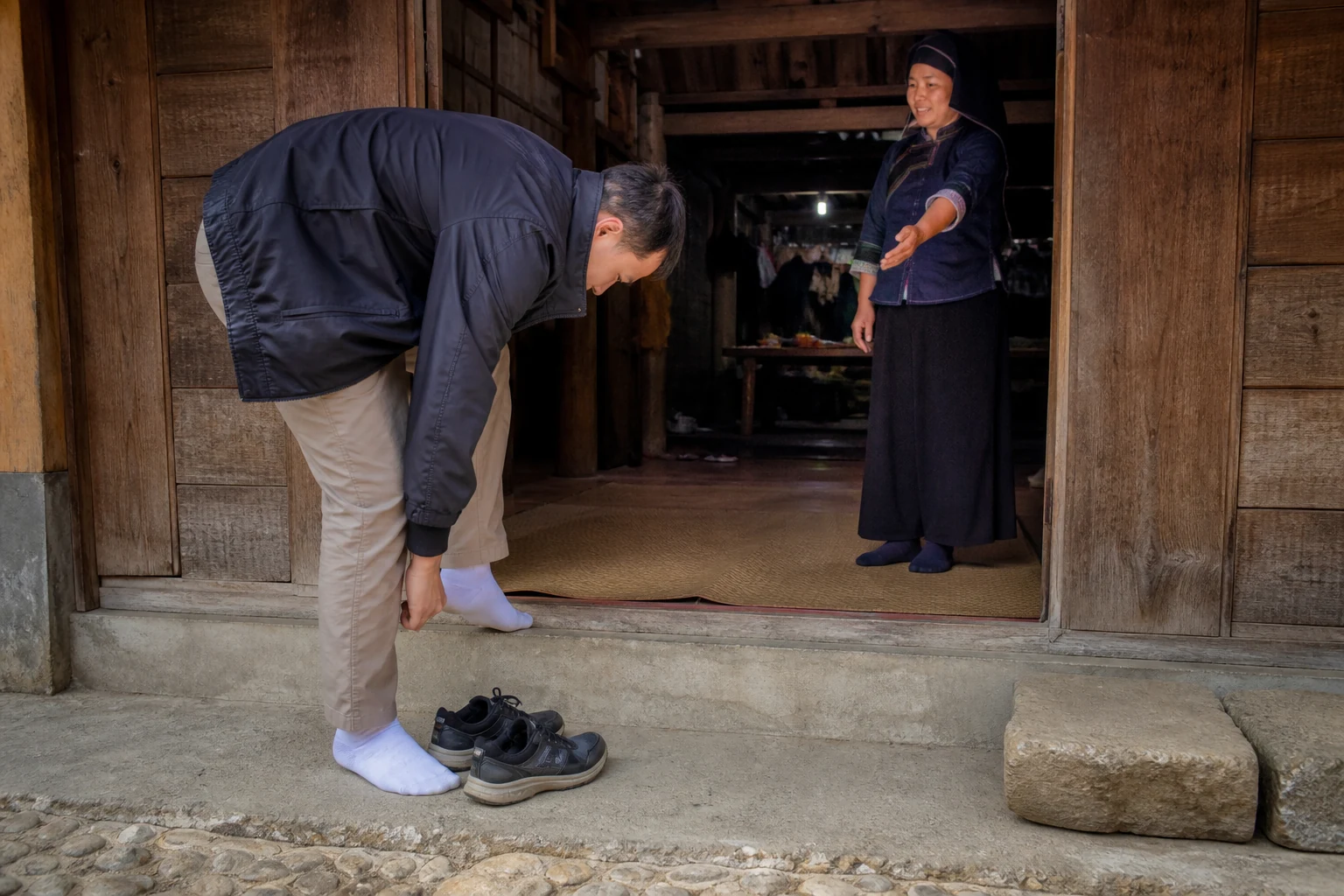
Dishes arrive in sequence, not all at once. Wait for the host or your guide to begin. Shoes stay at the threshold; the raised floor is a clean space.
- Lo Lo Chai to Then Pa
White Hmong homestay night on the border ridge.
- Nam Dam to Lung Tam
Hmong hamlet after the Day 2 forest ridge.
Rice wine and the round.
Rice wine is distilled in small copper stills behind many houses. It is poured generously, drunk in rounds and accompanied by a quiet, formal toast. Refusing is not rude — but accepting once is the warmer move.
Welcome tea at arrival is separate from the dinner rounds. Guides handle the toast language and pace — you sip, not shoot, unless the household insists on a festival mood.
Alcoholic beverages beyond welcome rice wine are excluded from programme prices on village treks — small cash for extra rounds at a market is your choice. One sip at lunch on a terrace day is enough if you are walking again within an hour.
Picnic lunches on the ridge.
Day 1 on Lo Lo Chai to Then Pa includes picnic lunch on the Ma Lung ridge — Hmong corn cakes, smoked sausage, fresh fruit. It is packed food eaten with a view, not a kitchen stop.
Du Gia's hosted lunch is Dao, not Hmong, but the upstream hamlet walk crosses Hmong corn fields first — you see the crop before you taste it at someone's table.
Vegetarian tables are available with notice at booking — tofu, mountain greens, soup, rice. Kitchens are home-scale; allergies need advance word, not a surprise at the threshold.
- Du Gia forest villages
River valley day with Hmong fields and Dao lunch.
What changes by month.
Harvest weeks bring more smoked meat dried for storage — richer soup, less fresh greens. Green season means more tender mountain vegetables and muddy paths between fields, not a different cuisine.
Market livestock sections at Meo Vac are loudest by 7am — meat for thang co arrives early. Buckwheat season on the ridge changes the view around your picnic, not necessarily the lunch box.
Cold months mean longer evenings by the hearth. Food stays simple; the conversation and woodsmoke matter as much as the plate.
- Best time to trek Ha Giang
Seasonal context for market and homestay meals.
Gifts, photos and the fair exchange.
A small gift from home — tea, a postcard — is welcomed but not expected. The hosted meal and guide wages are the fair exchange; gift-giving is discouraged on terrace programmes for the same reason.
Do not photograph people without asking, especially elders and children at the table. Hmong weaving at Then Pa and market textiles are for sale — buying cloth supports the weaver; photographing without purchase does not.
Community fees in your booking reach the hamlet fund before you walk. That is how hosting stays a household decision rather than a performance.
Water, hygiene and stomach sense.
Drinking water is provided on all programmes — refill at the homestay before a long ridge with no stream for the first hours. Boiled tea is safe; river water is not.
Homestay squat toilets sit outside the stilt house — headlamp essential after dark. Quick-dry towel and modest sleepwear for shared rooms.
If you are sensitive to offal or strong broth, say so at booking — thang co can be avoided; homestay soup can be kept mild.
- Packing for Ha Giang
Headlamp, towel and trail snacks.
Common questions.
Will I eat Hmong food on every trek?
Only on routes with Hmong homestays or ridge picnics — Lo Lo Chai to Then Pa, Nam Dam Day 2, and field crossings above Du Gia. Hoang Su Phi routes are La Chi, Red Dao and Tay kitchens.
Is thang co mandatory?
No. It is a market speciality. Homestay dinners are pork, greens, corn and rice — familiar enough if you are an adventurous eater.
Can vegetarians join?
Yes with notice — tofu, mountain greens, soup and rice from the same kitchen.
What about rice wine if I do not drink?
Decline politely or touch the cup without drinking. Guides explain in local language so no offence is taken.
Should I bring snacks?
Trail snacks and fruit are included. Personal chocolate or energy bars are fine — share if you like, not required.
Come hungry, leave unhurried.
Hmong food makes sense on the ridge where it is grown — corn cake at 1,500 m after a morning climb, smoke from the kitchen when you arrive at dusk, one cup of wine before sleep.
Pick a village route that includes a Hmong homestay if the table matters as much as the trail. Read homestay etiquette and market timing, then tell us dietary needs when you enquire.
Published by Ha Giang Trekking — field knowledge from local trail guides on the routes described, checked against programme schedules and operating notes.
Journal pages are for route research and planning. Dates, prices, day-by-day schedules and enquiry sit on programme and tour pages.
Articles are published under Ha Giang Trekking. Named writer and guide bylines will be added when verified bios and consent are on file.
Operational details on programme and tour pages are published only after being checked against current operating information.
Compare published routes and open the programme or journey page when you are ready to enquire.
- Hoang Su Phi — compare terrace programmes
One- to three-day terrace and homestay routes in the west of the province.
- Village treks — compare valley routes
Valley and plateau village circuits with homestay nights.
- Ridge & Cloud — compare summit programmes
Summit ridges and cloud-forest massifs above the terrace country.
- Extended journeys — multi-day loops
Four- to seven-day journeys across Dong Van, Ma Pi Leng and the northern plateau.
- Ban Phung — highest terraces (1 day)
Ban Phung — highest terraces (1 day) — dates, pricing and enquiry.
- Du Gia forest villages (1 day)
Du Gia forest villages (1 day) — dates, pricing and enquiry.
- Chieu Lau Thi — sunrise ridge (1 day)
Chieu Lau Thi — sunrise ridge (1 day) — dates, pricing and enquiry.
- Dong Van Karst Traverse
Dong Van Karst Traverse — full itinerary and enquiry.
- Hidden Valleys Slow Trek
Hidden Valleys Slow Trek — full itinerary and enquiry.
- Private Hoang Su Phi to Dong Van Hiking Journey
Private Hoang Su Phi to Dong Van Hiking Journey — full itinerary and enquiry.